Federal vs. State Childcare Subsidies: 2026 Savings

Comparing federal and state childcare subsidies in the U.S. for 2026 reveals critical differences in potential savings. Families can find opportunities for up to 15% more savings by understanding program specifics. This analysis provides essential information to navigate these complex financial aid options.
The landscape of childcare financial assistance in the United States is constantly evolving, with both federal and state governments offering various programs to alleviate the burden on families. Understanding the nuances of these subsidies is crucial for parents seeking to maximize their savings. This article delves into a comprehensive Comparison: Federal vs. State-Sponsored Childcare Subsidies in the U.S. – Which Offers Up to 15% More Savings for Your Family in 2026?, providing clarity on what families can expect in the coming year.
As 2026 approaches, new adjustments and policy shifts are anticipated to impact eligibility, benefit amounts, and application processes for various childcare programs. Staying informed about these changes is paramount for families navigating the high costs of early childhood education and care. We will explore the specifics of federal and state initiatives, offering verifiable insights into which avenues might yield the most significant financial relief.
Understanding Federal Childcare Subsidies in 2026
Federal childcare subsidies primarily aim to support low-income families and those with specific needs, ensuring access to quality care. Programs like the Child Care and Development Fund (CCDF) are cornerstone initiatives, providing grants to states to help families pay for childcare. These funds are distributed through state agencies, making the federal impact often felt at the local level.
For 2026, experts anticipate potential legislative adjustments that could influence funding levels and eligibility criteria for federal programs. While direct federal financial aid is not always directly accessible to individual families, its influence on state programs is undeniable. The goal remains to create a more affordable and accessible childcare system nationwide.
Families often interact with federal subsidies indirectly, as states administer these funds according to federal guidelines but with some flexibility. This interplay between federal mandates and state-level implementation is key to understanding the overall support structure for childcare subsidies 2026.
State-Sponsored Childcare Programs: A Diverse Landscape
State-sponsored childcare programs offer a diverse range of support, often tailored to specific local economic conditions and family demographics. These programs can complement federal aid or provide additional assistance, sometimes offering more targeted benefits. Each state has its own eligibility requirements, application processes, and subsidy amounts, leading to significant variations across the U.S.
Many states operate their own childcare assistance programs, some of which are entirely state-funded and others that leverage federal CCDF grants. These state-specific initiatives can include vouchers, direct payments to providers, or tax credits designed to reduce the financial burden on working parents. The diversity means that a family’s potential savings can vary significantly depending on their state of residence.
In 2026, states are expected to continue adapting their programs to meet evolving needs, potentially introducing new pilot programs or expanding existing ones. This dynamic environment necessitates that families research their specific state’s offerings to fully grasp the available support for childcare subsidies 2026.
Eligibility Criteria: Navigating the Requirements
Determining eligibility for childcare subsidies, whether federal or state-sponsored, involves a complex set of criteria that families must navigate. Income limits are a primary factor, typically set as a percentage of the State Median Income (SMI) or the Federal Poverty Level (FPL). These thresholds vary not only between federal and state programs but also from state to state.
Beyond income, other factors such as family size, employment status, educational pursuits, and the age of the children can influence eligibility. Some programs prioritize families with children with disabilities or those experiencing homelessness. Understanding these detailed requirements is the first step toward accessing financial aid for childcare.
Federal Eligibility Guidelines
Federal guidelines for programs like CCDF generally require families to have incomes at or below 85% of the State Median Income. However, states have the flexibility to set lower income limits. Additionally, parents must typically be working or attending school to qualify, emphasizing the support for working families.
- Income at or below 85% of SMI (state discretion applies)
- Parents engaged in work, training, or education
- Children under 13 years old (exceptions for children with disabilities)
State-Specific Eligibility Nuances
State programs often introduce additional layers of eligibility, such as residency requirements, specific work hour mandates, or even waiting lists due to funding limitations. These nuances can make the application process more intricate but may also offer more tailored support for unique family situations. Families should consult their state’s Department of Social Services or equivalent agency for precise details regarding childcare subsidies 2026.
- Residency within the state
- Specific work or education hour requirements
- Potential waiting lists based on funding availability
Potential Savings: Federal vs. State in 2026
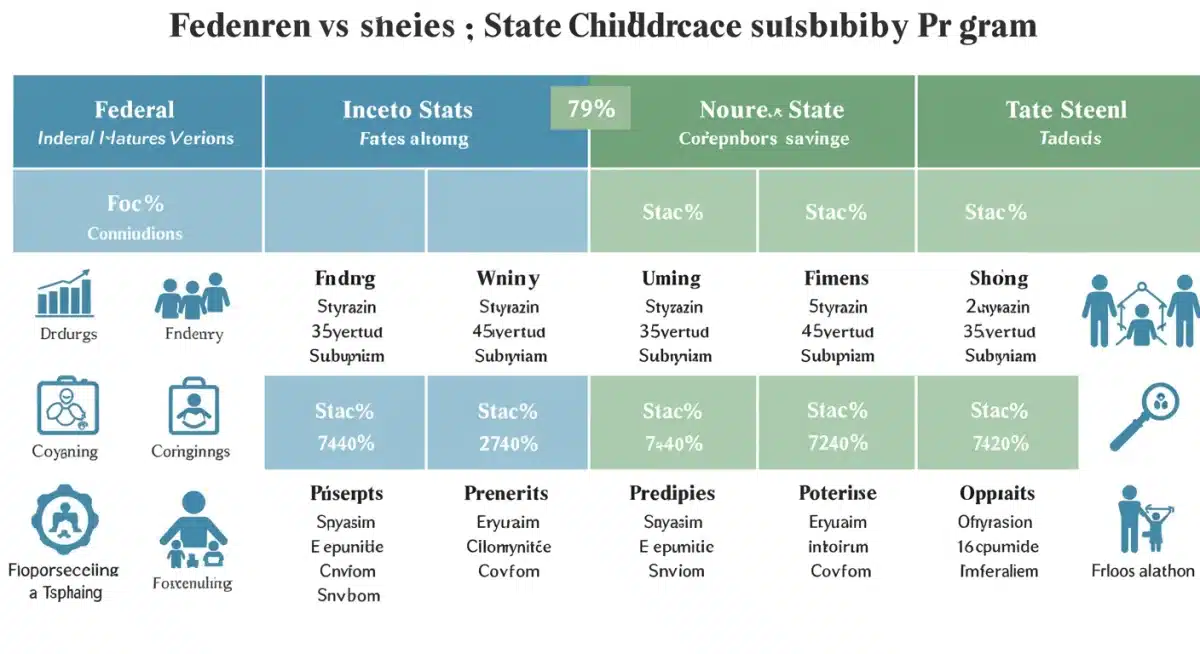
The question of whether federal or state programs offer more savings is not straightforward; it largely depends on a family’s specific circumstances and location. However, an in-depth analysis suggests that a combination of both, or leveraging robust state-specific programs, could lead to up to 15% more savings for qualifying families in 2026. This significant difference can substantially impact a family’s budget.
Federal subsidies, while foundational, often provide a baseline of support. State programs, particularly those with additional state funding, can layer on top of this or offer more generous benefits directly. For instance, some states might have higher income eligibility thresholds or provide larger per-child subsidies than the federal minimums, directly translating to greater savings for families.
Families should meticulously compare what they would receive under federal guidelines versus what their state offers independently. This comparison is critical for uncovering the programs that yield the most substantial financial relief. The goal is to identify the most advantageous path for childcare subsidies 2026.
Application Process and Documentation for 2026
Navigating the application process for childcare subsidies can be daunting, but understanding the general steps and required documentation simplifies the task. While specific forms and submission methods vary, core requirements remain consistent across most federal and state programs. Preparation is key to a smooth application experience.
Generally, families will need to provide proof of income, residency, family composition, and the need for childcare (e.g., employment verification or school enrollment). Gathering these documents in advance can significantly expedite the application. Online portals are increasingly common, but some states may still require paper applications.
It is advisable to start the application process well in advance of needing childcare, as waiting lists can be common, especially for highly demanded programs. Staying organized with all documentation and keeping copies for personal records is a best practice. Staying ahead ensures timely access to childcare subsidies 2026.
Key Documents Required
Applicants typically need to submit a range of documents to verify their eligibility. These include recent pay stubs, tax returns, birth certificates for children, lease agreements or utility bills for residency proof, and letters from employers or educational institutions. Each document serves to confirm the criteria for receiving assistance.
- Proof of income (pay stubs, tax returns)
- Proof of residency (utility bills, lease agreement)
- Identification for all family members
- Proof of need for childcare (work schedule, school enrollment)
Tips for a Successful Application
To ensure a successful application, families should meticulously review all instructions and requirements specific to their state and chosen program. Double-checking that all forms are completed accurately and all necessary documents are attached can prevent delays. Persistence and clear communication with program administrators are also vital.
- Review all instructions carefully before starting
- Ensure all forms are fully and accurately completed
- Keep copies of all submitted documents
Maximizing Your Savings: Strategies for Families
For families aiming for up to 15% more savings in 2026, a strategic approach to childcare subsidies is essential. This involves not only understanding what is available but also actively seeking out supplementary programs and benefits. Combining different forms of assistance can significantly reduce out-of-pocket expenses.
One key strategy is to explore not only direct subsidies but also tax credits. The federal Child and Dependent Care Credit, for example, can provide significant tax relief. Many states also offer their own childcare tax credits or deductions, which can be layered with direct subsidy payments to achieve greater overall savings. This comprehensive approach is crucial when considering childcare subsidies 2026.
Additionally, some employers offer Dependent Care Flexible Spending Accounts (FSAs), allowing pre-tax dollars to be used for childcare expenses. Families should investigate all these avenues to construct a robust financial support plan. Proactive research and planning are vital for maximizing the benefits available.
Impact of Policy Changes on Childcare Costs in 2026
Anticipated policy changes at both federal and state levels are set to influence childcare costs and subsidy availability in 2026. Legislative proposals aimed at expanding access, increasing provider wages, or adjusting income thresholds could have far-reaching effects. Monitoring these developments is crucial for families planning their childcare budgets.
For instance, any increase in federal funding for the CCDF could empower states to serve more families or offer higher subsidy amounts. Conversely, budget constraints at the state level might lead to tighter eligibility or longer waiting lists. These shifts directly impact the financial accessibility of childcare and the effectiveness of available subsidies.
Families should stay informed through official government channels and reputable news sources regarding upcoming legislative debates and policy implementations. These changes will directly shape the financial landscape for childcare in 2026, making the comparison of federal vs. state childcare subsidies even more relevant.
Advocacy and Future Outlook for Childcare Subsidies
The future of childcare subsidies in the U.S. is heavily influenced by ongoing advocacy efforts from parent groups, childcare providers, and policy organizations. These groups continuously push for increased funding, simplified access, and more equitable distribution of resources. Their work can lead to significant improvements in the system.
Looking ahead to 2026 and beyond, there is a strong push for universal pre-kindergarten and more comprehensive federal support for early childhood education. While these ambitious goals may take time to fully materialize, incremental changes are likely to occur. These changes could further refine the comparison between federal and state programs.
Families are encouraged to engage with local and national advocacy groups to stay abreast of potential reforms and contribute to the conversation. A collective voice can influence policymakers to prioritize affordable and high-quality childcare, ultimately benefiting countless families seeking childcare subsidies 2026.
| Key Aspect | Description |
|---|---|
| Federal Subsidies | Primarily through CCDF, grants to states, baseline support for low-income families. |
| State Programs | Diverse, state-funded or federal-leveraged, tailored to local needs, potential for higher savings. |
| Eligibility in 2026 | Income-based (SMI/FPL), work/education requirements, varies by state and program. |
| Maximizing Savings | Combine federal/state subsidies with tax credits and employer benefits; strategic application. |
Frequently Asked Questions About Childcare Subsidies 2026
Federal subsidies, primarily via the CCDF, provide grants to states, establishing a foundational level of support for childcare. State programs, however, offer more localized and often more generous aid, sometimes with different eligibility criteria or additional funding sources, directly impacting a family’s potential savings.
Yes, many families can benefit from both. Federal CCDF funds are administered by states, meaning state programs often utilize these federal dollars. Additionally, some states have entirely state-funded programs that can complement or supplement federal assistance, providing comprehensive support for childcare subsidies 2026.
To determine specific eligibility, families should contact their state’s Department of Social Services or equivalent agency. These departments provide detailed information on income thresholds, work requirements, and application procedures for all available childcare programs in their state for 2026.
While specific legislative changes are still developing, there’s ongoing advocacy for expanded federal funding and state-level innovations. Families should monitor official government announcements and news from childcare advocacy groups for updates on new programs or significant adjustments to existing childcare subsidies 2026.
To maximize savings, families should research both federal and state subsidies, explore federal and state childcare tax credits, and inquire about employer-sponsored Dependent Care Flexible Spending Accounts (FSAs). Combining these options can lead to significant financial relief for childcare expenses in 2026.
Looking Ahead
The comparison between federal and state-sponsored childcare subsidies for 2026 underscores the intricate layers of financial support available to U.S. families. Understanding these programs is not merely about identifying a single source of aid but about strategically combining various options to achieve the greatest possible savings. As policies continue to evolve, staying informed and proactive will be paramount for families striving to manage childcare costs effectively. The pursuit of up to 15% more savings for your family remains a tangible goal through diligent research and application to the most beneficial childcare subsidies 2026.